- Free Consultation 24/7: 305-373-0550 Tap Here To Call Us




Was Your Fall Caused by a Werner Multi-Max Pro Ladder Lock?


If a Werner Multi-Max Pro ladder’s locking mechanism failed and you or a loved one fell and were injured, you may be able to pursue a product liability claim for medical bills, lost income and pain and suffering, similar to the claims raised in a recent Werner Multi-Max Pro ladder lawsuit. Call 800-337-7755 for a free case review.
What the Werner Multi-Max Pro Ladder Lawsuit Alleges
A product liability lawsuit involving the Werner Multi-Max Pro ladder alleges that the ladder’s locking mechanism failed during use and caused a fall that led to severe injuries.
The Multi-Max Pro is a multi-position ladder. It is built to change between several configurations, which means it relies on hinges and locks to stay rigid once it is set. When a lock engages correctly, the ladder is meant to feel solid. When a lock appears engaged but is not fully seated, or releases under load, the ladder can shift or collapse with very little warning. Those are the kinds of concerns at the center of this lawsuit.
How a Locking Mechanism Failure Can Lead to a Serious Fall
Ladder falls often happen in a split second. A person climbs, shifts their weight, reaches for a tool, and the ladder moves in a way they did not expect. With an articulating or multi-position ladder, a locking failure may cause:
- Sudden folding at a hinge: one section collapses toward the other while someone is standing on it.
- Uneven height or tilt: one side drops, throwing the user off balance.
- False engagement: a lock looks or sounds secure but is not fully seated.
- Release under load: the lock holds at first, then lets go once weight is applied.
Even a fall from a modest height can cause life-changing harm. Injuries in ladder cases may include broken wrists, arms and hips, head injuries and concussions, spinal injuries, shoulder and knee damage, and in some cases injuries that require surgery and long recovery periods.
Who May Be Responsible When a Ladder Fails
Under Florida law, a person injured by a defective product may be able to bring a claim against the manufacturer and, in some situations, others in the chain of distribution, such as a retailer. These claims generally fall into a few categories:
- Design defect: the way the locking system was designed may make it unreasonably dangerous, even when built as intended.
- Manufacturing defect: a specific ladder or batch may have been made with flawed parts or assembly.
- Failure to warn: the instructions or labels may not have adequately explained how to confirm the locks were engaged or the risks if they were not.
- Negligence: a company may have failed to use reasonable care in testing, inspecting or responding to reports of problems.
Every case depends on its own facts. How the ladder was set up, its age and condition, and what happened just before the fall can all matter. An experienced product liability attorney can review those details and explain which claims may apply.
Examples of Situations That May Lead to a Claim
The following are general examples to help readers recognize situations that may be worth a closer look. They are not actual cases or results.
- A homeowner painting indoors: sets up the ladder in stepladder mode, hears the locks click, and climbs. Partway up, one side folds inward and the homeowner falls onto a hard floor, breaking a wrist.
- A contractor on a job site: uses the ladder in extension mode against a wall. A hinge lock releases while the worker is near the top, and the fall leads to a back injury and time away from work.
- An older adult hanging decorations: follows the instructions as written, but the label does not clearly show how to confirm full engagement. A partial lock gives way, causing a hip fracture.
Workplace injuries can also involve workers’ compensation. In some situations, an injured worker may have both a workers’ compensation claim and a separate product liability claim against the ladder manufacturer.
What to Do After a Werner Ladder Fall
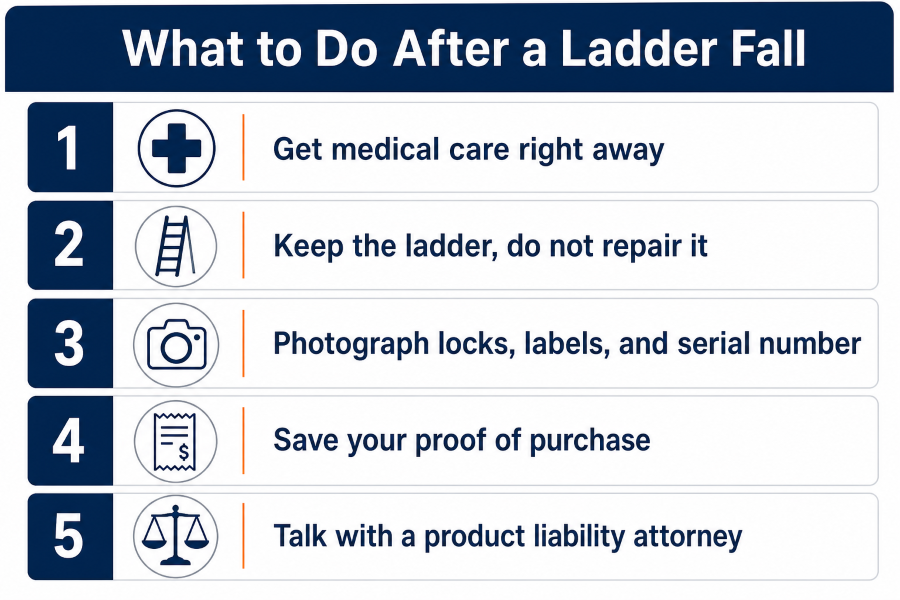
The steps you take after a fall may help protect a potential claim:
- Get medical care: some injuries, especially head and spinal injuries, may not show symptoms right away.
- Keep the ladder: do not repair it, throw it away or return it. The ladder itself may be the most important evidence.
- Take photos: photograph the ladder, the locks, labels, model information and the scene of the fall.
- Save your receipt: proof of purchase can help show where and when the ladder was bought.
- Write down what happened: note how the ladder was set up and what you saw or heard before it failed.
- Talk to a lawyer before giving statements: manufacturers and insurers may ask questions designed to shift blame to the user.
Florida law sets deadlines for injury claims, and some claims may need to be filed within two years. Waiting can make it harder to preserve evidence, so speaking with a lawyer sooner rather than later may help.
Why Choose the Law Offices of Jason Turchin
The Law Offices of Jason Turchin is a personal injury firm based in Weston, Florida. The firm handles personal injury cases in Florida, New York, New Jersey and Washington, D.C., and throughout the U.S. with a network of co-counsels and local counsels. That reach can matter in defective product cases, where the company that made the product and the place of the injury may be in different states.
Attorney Jason Turchin has received an Avvo 10.0 Superb Rating and is AV Preeminent Peer Rated for Highest Level of Professional Excellence by Martindale-Hubbell in 2026. He has been named to the Super Lawyers list from 2020 through 2026, and the firm has held an A+ BBB rating annually from 2014 through 2026. He is also a #1 Best Selling Author on Amazon.com on Accident Law.
Cases are handled on a contingency fee basis, with fees and costs waived if there is no recovery. That means injured people can have their ladder fall reviewed without paying anything upfront.
Frequently Asked Questions
Has a court found the Werner Multi-Max Pro ladder defective?
The lawsuit contains allegations that the locking mechanism failed. Allegations are not findings, and Werner can contest them. Your own claim would depend on the facts of your fall and the condition of your ladder.
Do I need to be part of the existing lawsuit to file a claim?
Not necessarily. An injured person may be able to bring an individual claim based on their own injuries. A lawyer can explain the options that may fit your situation.
What if I set up the ladder myself?
Many ladder injuries happen to people who set up the ladder on their own. Manufacturers may argue user error, but a product may still be considered defective if the locks were poorly designed, made incorrectly or not clearly explained in the warnings.
I already threw away the ladder. Can I still have a case?
It may be harder, but it is not always the end of a claim. Photos, receipts, witness accounts and medical records may still help. Speak with a lawyer about what evidence remains.
How much does it cost to talk to a lawyer?
The case review is free, and the firm handles cases on a contingency fee basis, with fees and costs waived if there is no recovery.
Can I report the ladder problem to a government agency?
Yes. Consumers can report product safety concerns to the U.S. Consumer Product Safety Commission. Reporting does not replace a legal claim, but it may help document the issue.
Talk to a Werner Ladder Injury Lawyer Today
If a Werner Multi-Max Pro ladder lock failed and you were hurt, you may have the right to seek compensation. Keep the ladder, get medical care and reach out to learn about your options. Call 800-337-7755 or contact the Law Offices of Jason Turchin online for a free, no-obligation case review.